

Customer Experience Platforms
Better tools for your people. Better experiences for your customers. Better outcomes for your business.

Why customer experience gets harder to manage over time
Most customer experience setups don't start out tangled, they get that way. A phone system here, a CRM there, a chat tool, a reporting spreadsheet. Each one made sense on its own. Together, they slowly turn into friction.
Before long your team is switching between screens to piece together a single conversation, customers are repeating themselves, and you can't easily see what's working or why. As volumes grow and AI starts handling more of the front line, those gaps get more expensive - harder to scale, harder to staff, and harder to fix once they're set in.

Voice, chat, CRM, and digital channels run separately, meaning customers repeat themselves and conversations feel disjointed.
Reporting and insight are scattered across systems, so spotting a problem, or proving what's actually working, gets harder.
Agents jump between screens and lean on manual workarounds, slowing everything down and quietly inviting mistakes.
Customer experience spans several teams and your people end up manually holding disconnected tools and workflows together.
Modern CX needs skills across integrations, automation, AI, and more which is usually more than a team your size can realistically hire and retain.
Overlapping tools, duplicate licences, and hours lost to manual work all increase what each customer interaction really costs you.
Understand how connected your customer experience really is
Most organisations can list the platforms involved in customer experience. Fewer can clearly see how well those platforms, workflows, reporting, and customer interactions actually work together.
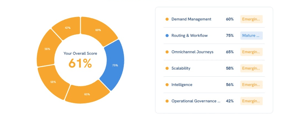
In a short, structured snapshot, a Babble specialist helps you score how your customer experience is performing today across six key areas, so you can see exactly where the gaps are and which fixes will have the biggest impact first. You'll come away with a clear picture of your setup and a shortlist of where to start.
It takes about 15 minutes, uses what you already know, and there's no obligation to do anything with it.
What the Snapshot helps you understand:
- How customer interactions flow across your channels and systems
- Where workflows, reporting, or tools are quietly pulling apart
- How smoothly your team handles day-to-day enquiries
- Where automation or AI could take work off your plate
- What the gaps are costing you in time, effort, and repeat contacts
- Where to focus first for the biggest impact
What changes when everything connects
When everything runs as one connected system, customers get a smoother experience, your team spends less time firefighting, and you can finally see, and improve, what's happening across the business.
Customers move between channels without starting over, because your systems and teams finally share the same picture.
- Full context on every interaction
- Consistent experiences, fewer repeated conversations
You can see how your channels, teams, and interactions are performing, in one place, in plain terms.
- Insight you can actually trust and act on
- Faster, more confident decisions
Your agents stop fighting disconnected tools and manual work, so they can spend their time on customers.
- Less screen-switching and manual effort
- Faster responses and quicker resolutions
Your setup gets better as expectations rise and AI matures, instead of quietly falling behind.
- Continuous improvement from real insight, not guesswork
- Automation and AI added where they actually help
Most of the technology is already there. The value is in joining it up.
Most organisations already have many of the right tools - voice, CRM, chat, reporting, automation. The value isn't in replacing them; it's in connecting them so they work as one.
That's usually where the gaps show up first, and that's what Babble does. We assess, design, implement, manage, and keep evolving your customer experience technology to match your customer's expectations. This means conversations, workflows, and reporting stay consistent as you grow.

Voice, messaging, chat, and digital - the tools your customers reach you on, connected and improved so they work as one.
CRM, reporting, and analytics that give your team the full picture of each customer, and you a clear view of what's happening.
Routing, automation, and AI-assisted handling that take repetitive work from your team and keep service consistent.
The platforms your people use daily, like Microsoft Teams, connected so customer-facing and back-office teams work together.

Ways to improve your customer experience
Improving customer experience isn't about adding more channels. It's about making the tools you already have work together, so your service gets more consistent, your people are more connected, and you can scale without the cracks showing.

Delivered with Five9 or Talkdesk
A modern contact centre that brings voice, digital, routing, journey mapping, automation, AI and reporting into one connected platform.
We help you choose between Five9 and Talkdesk based on how you actually operate, then set it up shaped around the optimum experience for your customers and your people.
This is the right next step if:
- Your agents juggle multiple screens to handle a single conversation
- Customers repeat themselves or get routed to the wrong place
- You can't easily see why handle times or resolution rates are slipping
- Manual work and disconnected systems are slowing your team down
No contact centre? The experience of your customers and your people still matters.
Bring your phone system and your collaboration tools into one place, so internal and customer-facing conversations stop living in separate worlds. Built around Microsoft Teams or Cisco Webex so it fits naturally with what your people already use every day.
This is the right next step if:
- You don't have a contact centre, but customer experience is crucial
- Your phone system runs separately to your other communications platforms
- Internal and customer conversations don't connect
- Your team is dispersed and hard to reach consistently
- Collaboration and customer communication feel disjointed
Trusted customer experience and communications partners
We work with the platforms businesses like yours across the globe already know and trust - Five9, Talkdesk, Microsoft Teams, Cisco Webex - and help you get the most from them.



How we deliver and keep improving your customer experience
Customer expectations, channels, and technology keep moving, and your platform needs to keep pace. That's why we follow a structured framework - AIME - to deliver your customer experience and keep improving it long after go-live..
We map how your customer journeys, workflows, reporting, and integrations are performing today, and where the gaps and friction are building.
We design and build the right setup - platforms, workflows, automation, and communication tools - around what you already have, rather than ripping it out.
We support, optimise, and measure your setup day to day, reporting on performance so you can see it's working and where it can be improved.
We keep improving workflows, automations, and the core platform as your business and your customers' expectations change, so your system gets better over time, not outdated.
This is how customer experience becomes easier to manage, improve, and scale over time rather than becoming more fragmented.
Through the implementation of Five9 Digital IVAs and Babble we have significantly reduced after call work, enhancing the customer experience while empowering agents with greater efficiency and flexibility.
Our credentials







Meet the customer experience platforms specialists
Behind every connected customer experience is a specialist team that knows how to join the pieces together. We work with businesses like yours to untangle disconnected tools, simplify how your team works, and make customer interactions more consistent.
Talk to us about how to:
- Make customer interactions more consistent
- Take friction and manual work from your team
- Get a clearer view across your journeys and reporting
- Use automation and AI where they actually help
- Work out the right next step for your setup
FAQs
It depends what you're trying to do and also, the two aren't really competitors. Microsoft Teams is the leading unified communications platform, and with the right configuration, it can handle voice, collaboration, and customer conversations very well in a mature unified communications environment. Where it isn't the right fit is when you're trying to run a contact centre.
Complex or skills-based routing, omnichannel queueing, and heavy reporting on things like sentiment, customer journeys, and handling performance are not possible in an out-of-the-box Teams environment. That's where a dedicated contact centre platform comes in. Plenty of businesses run both too, Teams for unified communications with a contact centre platform alongside it. We help you work out which side of that line you're on.
Read more:
When it takes real work from your team, not when it's bolted just because it's available. It earns its place handling repetitive questions, routing people correctly first time, and surfacing the right information so agents answer faster. It's less useful, and can backfire, when used to replace human help on complex or sensitive issues. The skill is knowing where that line sits.
Read more:
Licensing is usually the smallest part of your costs, but you should also budget for setup and integration, onboarding, and ongoing support. We give you a clear, itemised quote up front, so there are no surprises later.
Read more:
Rarely for technical reasons. The projects we see fail the most are usually caused by buying more features than anyone uses, no clear owner driving adoption, treating it as an IT install rather than a genuine change for your people, and not connecting it to the tools you already have. Get those right and most of the risk disappears.
Read more: